

Funding Opportunities

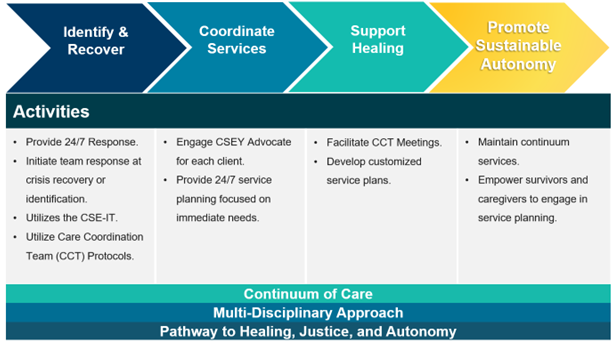
The purpose of this funding opportunity is to support programs to implement the Texas Model for Care Coordination for Commercially Sexually Exploited Youth (CSEY). The Care Coordination Model is a consensus-driven, collaborative approach to identify and recover CSEY, and to facilitate tailored, accessible, trauma-informed, and holistic resources through a coordinated network of providers. The target population is youth (0-17) with an option to serve transition-age youth (18-24), capacity permitting.
The goal of Care Coordination is that every identified child survivor of sex trafficking and exploitation has access to non-punitive, responsive, high-quality community-based services that meet their unique short-term and longer-term needs.
Care coordination employs awareness, education, creativity, collaboration, continuous learning, and capacity-building to identify and recover CSEY, and to facilitate tailored, accessible, trauma-informed, and holistic resources through a coordinated network of providers. Care coordination teams build trust, transparency, and solutions with each other to mitigate duplication of work, and so that local and statewide partners are bridges instead of barriers to services for children, youth, and families.
Information about other related funding opportunities is provided below and on the Funding Opportunities tab of the eGrants homepage:
Funding is authorized for these projects under the following sources:
State funds are authorized under the Texas General Appropriations Act, Article I for Trusteed Programs within the Office of the Governor. All awards are subject to the availability of appropriated funds and any modifications or additional requirements that may be imposed by law.
Applications may be submitted by non-profit corporations (including hospitals and faith-based organizations), counties applying to provide direct services to victims only, Native American tribes, and units of local government, which are defined as a non-statewide governmental body with the authority to establish a budget and impose taxes (includes hospital districts). Other local governmental agencies should apply through an associated unit of local government.
Applicants must access the Public Safety Office (PSO) eGrants grant management website at https://eGrants.gov.texas.gov to register and apply for funding.
Applicants are required to submit fully developed and detailed grant budgets at the time of application. The PSO will not accept placeholder applications and/or budget line items in lieu of a well written and detailed grant application.
Please note, applications submitted under this funding announcement will not be reviewed by a local Council of Governments (COG).
***NEW APPLICATION SUBMISSION REQUIREMENT***
The following documents must be submitted with the application for the application to be considered complete and eligible for funding. See the Eligibility Requirements and/or Program-Specific Requirements Sections of this Funding Announcement for more details on the requirements for each attachment/certification:
Failure to submit the fully executed required attachment(s) by the application deadline may result in the application being deemed ineligible.
Projects selected for funding must begin on or after 10/01/2026 and expire on or before 9/30/2027. Projects may not exceed a 12-month project period.
Minimum: $10,000
Maximum: None
Match Requirement: 20% of the total project
The match requirement may be met through cash or in-kind contributions.
Note: All applicants are strongly cautioned to only apply for funding they can responsibly expend in the grant period. The PSO will track expenditure rates throughout the life of the grant and may take action to avoid large de-obligations at the end of the grant period.
Grantees must comply with standards applicable to this fund source cited in the Texas Grant Management Standards (TxGMS), Federal Uniform Grant Guidance, and all statutes, requirements, and guidelines applicable to this funding.
Funding may be used to provide personnel and associated direct operating expenses to implement and maintain a 24-hour a day, 7 days a week (24/7) care coordination response.
All projects under this funding announcement must meet the following requirements:
1. Child Sex Trafficking Team Guiding Principles. Eligible applicants are required to adhere to the Guiding Principles of the Child Sex Trafficking Team (CSTT), where applicable. The CSTT’s Guiding Principles are:
a. We treat individuals who have experienced exploitation as victims and survivors, not perpetrators.
b. We are collaborative.
c. We are survivor informed.
d. Our systems and programs prioritize the needs of children and transition-age youth who have experienced exploitation and strive to give equal access to services regardless of system involvement.
e. We seek to prevent exploitation by educating the public, supporting protective factors for all children and transition-age youth, and by building resiliency among the most vulnerable.
f. Our approaches, systems and services are trauma-informed, responsive, and include trust-based relationships.
g. We develop and support community-based, sustainable resources and services.
h. We are committed to long-term individualized services, including planning for, and re-engaging with, children and transition-age youth after relapse.
i. We research the causes of and effective responses to exploitation and we evaluate and continuously improve our activities.
j. We work to prevent and reduce demand for exploitation and to hold all exploiters, including facilitators, and those who benefit from exploitation accountable.
2. Development and Utilization of Care Coordination Protocols. Care Coordination involves the interagency coordination of service planning and service delivery to meet the immediate and long-term needs of children and youth experiencing or at risk of experiencing commercial sexual exploitation. This collaboration must be memorialized through an agreed-upon protocol that addresses the Care Coordination Team’s referral process, crisis and non-crisis response, continuous service planning, and the roles of each partner agency. If established, please upload the most recent executed version of your community’s Care Coordination Protocols to the Upload.Files tab of eGrants.
Members of the Care Coordination Team (CCT) may include, but are not limited to:
Care Coordination Teams:
3. Advisory Council (AC) Development. The AC is comprised of senior leadership from CCT members and ensures the sustainability of Care Coordination. Supplemental guidance will be provided by the Office of the Governor.
4. Care Coordinator Responsibilities. The position of a Care Coordinator is held by an individual or individuals within a designated agency to support the ongoing administration of a community’s Care Coordination Protocols for Commercially Sexually Exploited Youth (CSEY). The Care Coordinator acts as the single point of contact for referrals to care coordination. Care Coordination programs funded by the Office of the Governor may accept referrals or requests for service from both non-investigatory entities, such as community partners, and from investigatory partners, such as law enforcement and the Department of Family and Protective Services as recommended by the designated Advisory Council and documented in the executed Care Coordination protocols. The Care Coordinator shares client information for the provision of services between selected partners as statutorily authorized or with guardian consent, and helps multiple systems and organizations collaborate as effectively as possible to both support the investigative process and coordinate long-term care for survivors, regardless of case status. Care Coordinators obtain and hold on file all necessary releases of information. Care Coordinators are responsible for initiating, facilitating, and/or following up on the following set of core activities.
In Initial Period of Crisis (within 24 hours) and Non-Crisis (within 72-96 hours) responses:
a. Actively receive calls 24/7 for the initiation of a rapid response for a crisis or non-crisis recovery of a victim.
b. Following CCT protocols to obtain consent, contact CSEY Advocate Agency.
c. Alert medical provider receiving victim from law enforcement (LE) or the Department of Family and Protective Services.
d. Notify CCT members of recovery or identification, or if child receives a score of Clear Concern on the CSE-IT.
e. Start care management file for survivor.
f. Initiate collection of information from participating CCT members and other involved parties as appropriate.
g. Coordinate Rapid Response Meeting (RRM) with CCT which includes notifying, scheduling, facilitating, and documenting RRM which captures all decisions and action plans.
h. Obtain CSE-IT score and document if not provided prior to RRM and/or complete CSE-IT during RRM, if applicable.
i. Notify residential and other service providers identified in RRM that referral will be forthcoming.
j. If applicable, follow up with entity responsible for submitting referral documentation to placement agency.
k. Maintain contact with CSEY Advocate Agency and/or others responding directly to victim and receive updates to inform decisions that will be made in first few days.
After Crisis and Non-Crisis Responses:
a. Immediately notify CCT of any information regarding critical change or if a missing event occurs.
b. Convene Service Status Meetings (SSMs), inviting assigned staff from DFPS and law enforcement, prosecutors, juvenile justice, court appointed special advocate (CASA), CSEY Advocate, relevant service providers, family advocate, all other victim witness advocates, and the non-offending caregiver and survivor as appropriate.
c. Attend or facilitate traditional MDT case staffings, as invited and in accordance with local CAC MDT guidelines, for duration of case. While Care Coordination complements the MDT, SSMs and a client’s enrollment in Care Coordination continue regardless of criminal case status, with an emphasis on service planning.
d. Receive referrals from Care Coordination Team partners for those receiving a score of Clear Concern on the CSE-IT – to enroll into Care Coordination. Conduct subsequent RRMs and SSMs.
e. Document activities and decisions reached in SSMs and communicate decisions to applicable parties.
f. Maintain contact with CSEY Advocate, non-offending caregiver(s), and others working with survivor regarding needs identified in SSMs.
g. Collects and reports care coordination performance data to CSTT.
5. Ongoing Partner and Community Training. Care Coordinators educate the community and CCT members about the Texas Model of Care Coordination, human trafficking 101, the CSE-IT, and encourage CCTS to provide similar trainings as appropriate.
6. On-call Services. Applicant agencies must be adequately staffed to provide care coordination 24 hours a day, 7 days a week.
7. Commercial Sexual Exploitation-Identification Tool (CSE-IT). The Commercial Sexual Exploitation Identification Tool (CSE-IT) is required to determine eligibility for services funded by this award. A CSE-IT screening must be conducted in Lighthouse for each client entering Care Coordination services. Scores of Clear Concern must be reported to DFPS Statewide Intake. Projects funded under this award are required to serve clients who receive a score of Clear Concern, meaning a number of 9-23 on the CSE-IT.
8. Community Support.
a. Established Care Coordination Entities: Applicant organizations must include executed letters of intent or memorandums of agreement from the Care Coordination Advisory Council which specifically denote the primary agency for care coordination.
b. Developing Care Coordination Entities: Applicant organizations must demonstrate robust community support for their project. This should include letters of support from all intended Care Coordination Advisory Council partner organizations including law enforcement and prosecutorial agencies. A letter of support or letter of commitment from the Department of Family and Protective Services (DFPS) is required: https://www.dfps.state.tx.us/Doing_Business/partnering.asp. Letters of support must be uploaded to the Upload. Files Tab of eGrants and signed by the appropriate leadership from each supporting agency. Please note that one letter of support signed by all Care Coordination Advisory Council partner organizations satisfies this requirement.
9. Trauma-Informed Response: Each application should include proposed strategies to ensure that Care Coordination participants receive a trauma-informed response. A trauma-informed response for this population should not be contingent upon a direct outcry of victimization.
10. Evidenced-Based Practices. Applications should identify specific recognized promising practices or evidence-based models for programmatic, skills-building, and clinical services the project plans to utilize to empower and build agency with survivors. This information should be reflected in the project’s response to “Evidence-Based Practices” under the Narrative tab of eGrants.
11. Access for Persons with Limited English Proficiency. Applicants are required to provide meaningful access to services for persons with Limited English Proficiency (LEP) and must maintain policies and procedures that document compliance with this requirement. A person with LEP is one whose first language is not English and who has a limited ability to read, write, speak, or understand English. Meaningful access may entail providing language assistance services, including oral interpretation and written translation, where necessary. In order to comply with this requirement, grantees are encouraged to consider the need for language accessibility services when developing program budgets.
12. Access for Persons with Disabilities. Applicants are required to provide equal access to services for clients with disabilities and must maintain policies and procedures that document compliance with this requirement. An individual with a disability is defined by the Americans with Disabilities Act of 1990 as a person who has a physical or mental impairment that substantially limits one or more major life activity, a person who has a history or record of such an impairment, or a person who is perceived by others as having such an impairment. In order to comply with this requirement, grantees are encouraged to consider the need for accessibility services for persons with disabilities when developing program budgets.
13. Organizational Chart. Applicants must upload the project’s organizational chart illustrating administrative, clinical, and programmatic leadership. Upload documentation to the Upload.Files tab of eGrants.
14. Project Evaluation: Recipients of funding under this announcement may be required to participate in a third-party evaluation and in improvement reviews performed by PSO. Grantees must make good-faith efforts to follow recommendations by the evaluator and PSO – including recommended project modifications – as a condition of ongoing funding.
15. Training and Technical Assistance: Recipients of funding under this announcement may be required to participate in training and technical assistance opportunities recommended by PSO. Grantees must make good-faith efforts to participate in designated training as a condition of ongoing funding.
16. Project Sustainability. Applicants must articulate their project’s plan for continued financial sustainability.
1. Applications from nonprofit corporations, local units of governments, and other political subdivisions must submit a fully executed resolution with the application to be considered eligible for funding. The resolution must contain the following elements (see Sample Resolution):
2. Entities receiving grant funds must demonstrate a record of effective services to victims of crime and financial support from sources other than the Crime Victims Fund; or substantial support from sources other than the Crime Victims Fund.
a. A program has demonstrated a record of effective direct services and support when, for example, it demonstrates the support and approval of its direct services by the community, its history of providing direct services in a cost-effective manner, and the breadth or depth of its financial support from sources other than the Crime Victims Fund.
b. A program has substantial financial support from sources other than the Crime Victims Fund when at least twenty-five percent of the program’s funding in the year of, or the year preceding the award comes from such sources.
3. Local units of governments must comply with the Cybersecurity Training requirements described in Section 772.012 and Section 2054.5191 of the Texas Government Code. Local governments determined to not be in compliance with the cybersecurity requirements required by Section 2054.5191 of the Texas Government Code are ineligible for OOG grant funds until the second anniversary of the date the local government is determined ineligible. Government entities must annually certify their compliance with the training requirements using the Cybersecurity Training Certification for State and Local Governments. A copy of the Training Certification must be uploaded to your eGrants application. For more information or to access available training programs, visit the Texas Department of Information Resources Statewide Cybersecurity Awareness Training page.
4. Entities receiving funds from PSO must be located in a county that has an average of 90% or above on both adult and juvenile dispositions entered into the computerized criminal history database maintained by the Texas Department of Public Safety (DPS) as directed in the Texas Code of Criminal Procedure, Chapter 66. The disposition completeness percentage is defined as the percentage of arrest charges a county reports to DPS for which a disposition has been subsequently reported and entered into the computerized criminal history system.
Counties applying for grant awards from the Office of the Governor must commit that the county will report at least 90% of convictions within five business days to the Criminal Justice Information System at the Department of Public Safety.
5. Eligible applicants operating a law enforcement agency must be current on reporting complete UCR data and the Texas specific reporting mandated by 411.042 TGC, to the Texas Department of Public Safety (DPS) for inclusion in the annual Crime in Texas (CIT) publication. To be considered eligible for funding, applicants must have submitted a full twelve months of accurate data to DPS for the most recent calendar year by the deadline(s) established by DPS. Due to the importance of timely reporting, applicants are required to submit complete and accurate UCR data, as well as the Texas-mandated reporting, on a no less than monthly basis and respond promptly to requests from DPS related to the data submitted.
6. In accordance with Texas Government Code, Section 420.034, any facility or entity that collects evidence for sexual assault or other sex offenses or investigates or prosecutes a sexual assault or other sex offense for which evidence has been collected, must participate in the statewide electronic tracking system developed and implemented by the Texas Department of Public Safety. Visit DPS’s Sexual Assault Evidence Tracking Program website for more information or to set up an account to begin participating. Additionally, per Section 420.042 "A law enforcement agency that receives evidence of a sexual assault or other sex offense...shall submit that evidence to a public accredited crime laboratory for analysis no later than the 30th day after the date on which that evidence was received." A law enforcement agency in possession of a significant number of Sexual Assault Evidence Kits (SAEK) where the 30-day window has passed may be considered noncompliant.
7. Local units of government, including cities, counties and other general purpose political subdivisions, as appropriate, and institutions of higher education that operate a law enforcement agency, must comply with all aspects of the programs and procedures utilized by the U.S. Department of Homeland Security (“DHS”) to: (1) notify DHS of all information requested by DHS related to illegal aliens in Agency’s custody; and (2) detain such illegal aliens in accordance with requests by DHS. Additionally, counties and municipalities may NOT have in effect, purport to have in effect, or make themselves subject to or bound by, any law, rule, policy, or practice (written or unwritten) that would: (1) require or authorize the public disclosure of federal law enforcement information in order to conceal, harbor, or shield from detection fugitives from justice or aliens illegally in the United States, 8 U.S.C. § 1324(a)(1)(A)(iii); (2) impede federal officers from exercising authority under 8 U.S.C. § 1226(a), § 1226(c), § 1231(a), § 1357(a), § 1366(1), or § 1366(3); (3) encourage or induce an alien to come to, enter, or reside in the United States in violation of law, 8 U.S.C. § 1324(a)(1)(A)(iv); (4) result in the illegal transport or movement of aliens within the United States, 8 U.S.C. § 1324(a)(1)(A)(ii) . Lastly, eligible applicants must comply with all provisions, policies, and penalties found in Chapter 752, Subchapter C of the Texas Government Code.
Each local unit of government, and institution of higher education that operates a law enforcement agency, must download, complete and then upload into eGrants the CEO/Law Enforcement Certifications and Assurances Form certifying compliance with federal and state immigration enforcement requirements. This Form is required for each application submitted to OOG and is active until August 31, 2027 or the end of the grant period, whichever is later.
8. Each non-profit 501(c)(3) organization must certify that it does not have, and will continue not to have any policy, procedure, or agreement (written or unwritten) that in any way encourages, induces, entices, or aids any violations of immigration laws. Additionally, the organization certifies that it does not have in effect, purport to have in effect, and is not subject to or bound by any rule, policy, or practice (written or unwritten) that would: (1) encourage the concealment, harboring, or shielding from detection of fugitives from justice or aliens who illegally came to, entered, or remained in the United States, 8 U.S.C. § 1324(a)(1)(A)(iii), or (2) impede federal officers from exercising authority under 8 U.S.C. § 1226(a), § 1226(c), § 1231(a), § 1357(a), § 1366(1), or § 1366(3); (3) encourage or induce an alien to come to, enter, or reside in the United States in violation of law, 8 U.S.C. § 1324(a)(1)(A)(iv); (4) result in the illegal transport or movement of aliens within the United States, 8 U.S.C. § 1324(a)(1)(A)(ii). Lastly, the organization certifies that it will not adopt, enforce, or endorse a policy which prohibits or materially limits the enforcement of immigration laws, and will not, as demonstrated by pattern or practice, prohibit or materially limit the enforcement of immigration laws.
Each non-profit organization must download, complete and then upload into eGrants the CEO/NGO Certifications and Assurances Form Certifying compliance with federal and state immigration enforcement requirements.
9. Eligible applicants must be registered in the federal System for Award Management (SAM) database and have an UEI (Unique Entity ID) number assigned to its agency (to get registered in the SAM database and request an UEI number, go to https://sam.gov/).
Failure to comply with program eligibility requirements may cause funds to be withheld and/or suspension or termination of grant funds.
Grant funds may not be used to support the unallowable costs listed in the Guide to Grants or any of the following unallowable costs:
1. Lobbying or advocacy activities with respect to legislation or to administrative changes to regulations or administrative policy (cf. 18 U.S.C. 1913), whether conducted directly or indirectly;
2. The active investigation and prosecution of criminal activity, except for the provision of victim assistance services (e.g., emotional support, advocacy, and legal services) to crime victims, under 28 CFR § 94.119, during such investigation and prosecution;
3. Any activities related to fundraising;
4. Capital improvements; property losses and expenses; real estate purchases; mortgage payments; remodeling; and construction;
5. Reimbursement of crime victims for expenses incurred as a result of a crime;
6. Salaries, benefits, fees, furniture, equipment, and other expenses of executive directors, board members, and other administrators;
Time spent by executive directors to perform or support direct services is allowable.
7. Counseling or treatment exclusively for substance use disorders;
Treatment for substance use disorders is permitted if the disorder is a result of victimization and is a component of the general counseling that an individual receives under this grant.
8. Victim-offender meetings that serve to replace (or as a part of) criminal justice proceedings;
9. Medical training;
10. Medical care or expenses (except as specifically allowed);
11. Forensic medical evidence collection to include the salary or overtime cost of SANE Nurses;
12. Cash payments to victims, gift cards, or fuel vouchers;
13. Creation of a voucher program where victims are directly given vouchers for such services as housing or counseling;
14. Transportation, lodging, per diem or any related costs for third-party participants to attend a training, when grant funds are used to develop and conduct training;
15. Leasing of vehicles;
16. Training of external partners or the community;
17. Program income;
18. Research and studies;
19. Activities that may compromise victim safety;
20. Entertainment, including amusement, diversion, social activities, field trips, excursions and any associated costs (i.e. tickets to shows or sports events, meals, lodging, rentals, transportation, and gratuities) unless there is a clear programmatic purpose and the costs are approved in advance by PSO;
21. Nonessential maintenance on buildings, lawn care, and landscaping; and
22. Any other prohibition imposed by federal, state or local law or regulation.
PSO will screen all applications to ensure that they meet the requirements included in the funding announcement.
Applications will then be reviewed by PSO staff members or a review group selected by the executive director. PSO will make all final funding decisions based on eligibility, reasonableness, availability of funding, and cost-effectiveness.
The Office of the Governor may not fund all applications or may only award part of the amount requested. In the event that funding requests exceed available funds, the Office of the Governor may revise projects to address a more limited focus.
For more information, contact the eGrants help desk at eGrants@gov.texas.gov or (512) 463-1919.


 Back to Top