

Funding Opportunities : Archive

RFA notices serve to inform potential applicants of available funding opportunities. In addition to an RFA, OOG may solicit applications for grants in the form of a Request for Proposals (RFP). Below lists each funding opportunity along with the method used to solicit applications and the deadline for submitting applications through eGrants to OOG. All awards are subject to the availability of appropriated funds and any modifications or additional requirements that may be imposed by law.
Page 6 of 6 pages ‹ First < 4 5 6
The Public Safety Office (PSO) is soliciting applications for preselected projects that support regional, multidisciplinary approaches to combat gang violence through the coordination of gang prevention, intervention, and suppression activities.
The following units of local government and state agencies are eligible to apply:
City of El Paso, City of Laredo, City of McAllen, City of North Richland Hills, City of San Antonio, City of Waco, Harris County, Lubbock County, and Smith County.
The Public Safety Office (PSO) is soliciting applications for preselected projects that support regional, multidisciplinary approaches to combat gang violence through the coordination of gang prevention, intervention, and suppression activities.
The following units of local government are eligible to apply:
City of El Paso, City of Laredo, City of McAllen, City of North Richland Hills, City of San Antonio, City of Waco, Harris County, Lubbock County, and Smith County.
The Public Safety Office (PSO) is soliciting applications for preselected projects that support regional, multidisciplinary approaches to combat gang violence through the coordination of gang prevention, intervention, and suppression activities.
The following units of local government are eligible to apply:
City of El Paso, City of Laredo, City of McAllen, City of North Richland Hills, City of San Antonio, City of Waco, Harris County, Lubbock County, and Smith County.
The Public Safety Office (PSO) is soliciting applications for preselected projects that support regional, multidisciplinary approaches to combat gang violence through the coordination of gang prevention, intervention, and suppression activities.
The following units of local government are eligible to apply:
City of El Paso, City of Laredo, City of McAllen, City of North Richland Hills, City of San Antonio, City of Waco, Harris County, Lubbock County, Midland County, and Smith County.
The purpose of this funding opportunity is to support programs to implement the Texas Model for Care Coordination for Commercially Sexually Exploited Youth (CSEY). The Care Coordination Model is a consensus-driven, collaborative approach to identify and recover CSEY, and to facilitate tailored, accessible, trauma-informed, and holistic resources through a coordinated network of providers.
The goal of Care Coordination is that every identified child survivor of sex trafficking and exploitation has access to non-punitive, responsive, high-quality community-based services that meet their unique short-term and longer-term needs.
Care coordination employs awareness, education, creativity, collaboration, continuous learning, and capacity-building to identify and recover CSEY youth, and to facilitate tailored, accessible, trauma-informed and holistic resources through a coordinated network of providers. Care coordination teams build trust, transparency and solutions with each other to mitigate duplication of work, and so that local and statewide partners are bridges instead of barriers to services for children, youth and families.
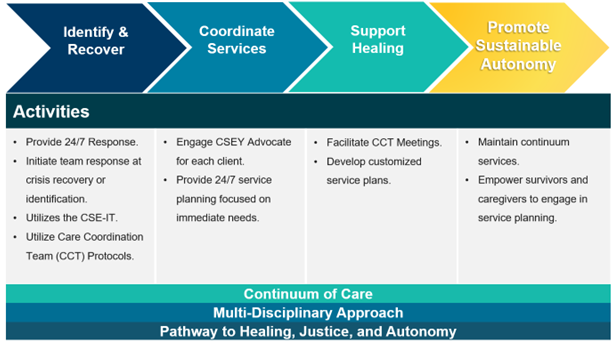
Applications may be submitted by Children’s Advocacy Centers as defined in Chapter 264, Subchapter E, Family Code, other non-profit corporations, and units of local government, which are defined as a non-statewide governmental body with the authority to establish a budget and impose taxes (includes hospital districts). Other local governmental agencies should apply through an associated unit of local government.
Additional eligibility requirements for grant applicants include: A) a track record of successful operations of the same or similar services for which funding is being pursued and, B) a positive history with, or the absence of a negative history with, OOG grants performance and management.
The purpose of this funding opportunity is to support programs to implement the Texas Model for Care Coordination for Commercially Sexually Exploited Youth (CSEY). The Care Coordination Model is a consensus-driven, collaborative approach to identify and recover CSEY, and to facilitate tailored, accessible, trauma-informed, and holistic resources through a coordinated network of providers. The target population is youth (0-17) with an option to serve transition-age youth (18-24), capacity permitting.
The goal of Care Coordination is that every identified child survivor of sex trafficking and exploitation has access to non-punitive, responsive, high-quality community-based services that meet their unique short-term and longer-term needs.
Care coordination employs awareness, education, creativity, collaboration, continuous learning, and capacity-building to identify and recover CSEY youth, and to facilitate tailored, accessible, trauma-informed, and holistic resources through a coordinated network of providers. Care coordination teams build trust, transparency, and solutions with each other to mitigate duplication of work, and so that local and statewide partners are bridges instead of barriers to services for children, youth, and families.
Information about other related funding opportunities is provided below and on the Funding Opportunities tab of the eGrants homepage:
Applications may be submitted by non-profit corporations and units of local government, which are defined as a non-statewide governmental body with the authority to establish a budget and impose.
The purpose of this funding opportunity is to support programs to implement the Texas Model for Care Coordination for Commercially Sexually Exploited Youth (CSEY). The Care Coordination Model is a consensus-driven, collaborative approach to identify and recover CSEY, and to facilitate tailored, accessible, trauma-informed, and holistic resources through a coordinated network of providers. The target population is youth (0-17) with an option to serve transition-age youth (18-24), capacity permitting.
The goal of Care Coordination is that every identified child survivor of sex trafficking and exploitation has access to non-punitive, responsive, high-quality community-based services that meet their unique short-term and longer-term needs.
Care coordination employs awareness, education, creativity, collaboration, continuous learning, and capacity-building to identify and recover CSEY, and to facilitate tailored, accessible, trauma-informed, and holistic resources through a coordinated network of providers. Care coordination teams build trust, transparency, and solutions with each other to mitigate duplication of work, and so that local and statewide partners are bridges instead of barriers to services for children, youth, and families.
Information about other related funding opportunities is provided below and on the Funding Opportunities tab of the eGrants homepage:
Applications may be submitted by non-profit corporations (including hospitals and faith-based organizations), counties applying to provide direct services to victims only, Native American tribes, and units of local government, which are defined as a non-statewide governmental body with the authority to establish a budget and impose taxes (includes hospital districts). Other local governmental agencies should apply through an associated unit of local government.
The Public Safety Office (PSO) is soliciting applications for projects that support state and local efforts to prevent terrorism and other catastrophic events and prepare for the threats and hazards that pose the greatest risk to the security of Texas citizens. PSO provides funding to implement investments that build, sustain, and deliver the 32 core capabilities essential to achieving a secure and resilient state.
Per Congressional mandate (911 Act), twenty-five percent (25%) of the combined Homeland Security Grant Program funding must be spent on Law Enforcement Terrorism Prevention Activities (LETPA). FEMA has increased this requirement to 35%. The purpose of this solicitation is to assist high-threat, high-density Urban Areas in efforts to build and sustain the capabilities necessary to prevent terrorist attacks and support critical prevention and protection activities. All LETPA investments must be consistent with capability targets set during the Threat and Hazard Identification and Risk Assessment (THIRA) process, and gaps identified in the State Preparedness Report (SPR).
The Urban Area Security Initiative (UASI) is intended to support investments that improve the ability of jurisdictions to:
Prevention is defined as the capabilities necessary to avoid, prevent, or stop a threatened or actual act of terrorism.
Many activities which support the achievement of target capabilities related to terrorism preparedness may simultaneously support enhanced preparedness for other hazards unrelated to acts of terrorism. However, all UASI-LETPA projects must assist grantees in achieving target capabilities related to preventing or thwarting an initial or follow-on terrorist attack.
*Note: All applicant entities must have a mission to serve in an Urban Area operational role or be partnering on plans, training, and exercises within the Urban Area.
The Public Safety Office (PSO) is soliciting applications for projects that support state and local efforts to prevent terrorism and other catastrophic events and prepare for the threats and hazards that pose the greatest risk to the security of Texas citizens. PSO provides funding to implement investments that build, sustain, and deliver the 32 core capabilities essential to achieving a secure and resilient state.
The purpose of this solicitation is to assist high-threat, high-density Urban Areas in efforts to build and sustain the capabilities necessary to prevent, protect against, mitigate, respond to, and recover from acts of terrorism. All investments must be consistent with capability targets set during the Threat and Hazard Identification and Risk Assessment (THIRA) process, and gaps identified in the Stakeholder Preparedness Review (SPR).
The Urban Area Security Initiative (UASI) is intended to support investments that improve the ability of jurisdictions to:
Many activities which support the achievement of target capabilities related to terrorism preparedness may simultaneously support enhanced preparedness for other hazards unrelated to acts of terrorism. However, all UASI projects must assist grantees in achieving target capabilities related to preventing, preparing for, protecting against, or responding to acts of terrorism.
*Note: All applicant entities must have a mission to serve in an Urban Area operational role or be partnering on plans, training, and exercises within the Urban Area.
The Public Safety Office (PSO) is soliciting applications for projects that support state and local efforts to prevent terrorism and other catastrophic events and prepare for the threats and hazards that pose the greatest risk to the security of Texas citizens. PSO provides funding to implement investments that build, sustain, and deliver the 32 core capabilities essential to achieving a secure and resilient state.
Per Congressional mandate (911 Act), twenty-five percent (25%) of the combined Homeland Security Grant Program funding must be spent on Law Enforcement Terrorism Prevention Activities (LETPA). FEMA has increased this requirement to 35%. The purpose of this solicitation is to assist high-threat, high-density Urban Areas in efforts to build and sustain the capabilities necessary to prevent terrorist attacks and support critical prevention and protection activities. All LETPA investments must be consistent with capability targets set during the Threat and Hazard Identification and Risk Assessment (THIRA) process, and gaps identified in the State Preparedness Report (SPR).
The Urban Area Security Initiative (UASI) is intended to support investments that improve the ability of jurisdictions to:
Prevention is defined as the capabilities necessary to avoid, prevent, or stop a threatened or actual act of terrorism.
Many activities which support the achievement of target capabilities related to terrorism preparedness may simultaneously support enhanced preparedness for other hazards unrelated to acts of terrorism. However, all UASI-LETPA projects must assist grantees in achieving target capabilities related to preventing or thwarting an initial or follow-on terrorist attack.
1. Eligible applicants must be located within a designated high-risk Urban Area receiving a FY 2024 federal allocation based upon an analysis of the relative risk of terrorism faced by the 100 most populous metropolitan statistical areas in the United States. Most recently, these areas in Texas include the Dallas/Fort Worth/Arlington Area, the Houston Area, the Austin Area and the San Antonio Area.
2. Applications from the following entities will be considered*:
*Note: All applicant entities must have a mission to serve in an Urban Area operational role or be partnering on plans, training, and exercises within the Urban Area
The Public Safety Office (PSO) is soliciting applications for projects that support state and local efforts to prevent terrorism and other catastrophic events and prepare for the threats and hazards that pose the greatest risk to the security of Texas citizens. PSO provides funding to implement investments that build, sustain, and deliver the 32 core capabilities essential to achieving a secure and resilient state.
The purpose of this solicitation is to assist high-threat, high-density Urban Areas in efforts to build and sustain the capabilities necessary to prevent, protect against, mitigate, respond to, and recover from acts of terrorism. All investments must be consistent with capability targets set during the Threat and Hazard Identification and Risk Assessment (THIRA) process, and gaps identified in the Stakeholder Preparedness Review (SPR).
The Urban Area Security Initiative (UASI) is intended to support investments that improve the ability of jurisdictions to:
Many activities which support the achievement of target capabilities related to terrorism preparedness may simultaneously support enhanced preparedness for other hazards unrelated to acts of terrorism. However, all UASI projects must assist grantees in achieving target capabilities related to preventing, preparing for, protecting against, or responding to acts of terrorism.
1. Eligible applicants must be located within a designated high-risk Urban Area receiving a FY 2024 federal allocation based upon an analysis of the relative risk of terrorism faced by the 100 most populous metropolitan statistical areas in the United States. Most recently, these areas in Texas include the Dallas/Fort Worth/Arlington Area, the Houston Area, the Austin Area and the San Antonio Area.
2. Applications from the following entities will be considered*:
*Note: All applicant entities must have a mission to serve in an Urban Area operational role or be partnering on plans, training, and exercises within the Urban Area
The Public Safety Office (PSO) is soliciting applications for projects that support state and local efforts to prevent terrorism and other catastrophic events and prepare for the threats and hazards that pose the greatest risk to the security of Texas citizens. PSO provides funding to implement investments that build, sustain, and deliver the 32 core capabilities essential to achieving a secure and resilient state.
Per Congressional mandate (911 Act), twenty-five percent (25%) of the combined Homeland Security Grant Program funding must be spent on Law Enforcement Terrorism Prevention Activities (LETPA). FEMA has increased this requirement to 35%. The purpose of this solicitation is to assist high-threat, high-density Urban Areas in efforts to build and sustain the capabilities necessary to prevent terrorist attacks and support critical prevention and protection activities. All LETPA investments must be consistent with capability targets set during the Threat and Hazard Identification and Risk Assessment (THIRA) process, and gaps identified in the State Preparedness Report (SPR).
The Urban Area Security Initiative (UASI) is intended to support investments that improve the ability of jurisdictions to:
Prevention is defined as the capabilities necessary to avoid, prevent, or stop a threatened or actual act of terrorism.
Many activities which support the achievement of target capabilities related to terrorism preparedness may simultaneously support enhanced preparedness for other hazards unrelated to acts of terrorism. However, all UASI-LETPA projects must assist grantees in achieving target capabilities related to preventing or thwarting an initial or follow-on terrorist attack.
1. Eligible applicants must be located within a designated high-risk Urban Area receiving a FY 2025 federal allocation based upon an analysis of the relative risk of terrorism faced by the 100 most populous metropolitan statistical areas in the United States. Most recently, these areas in Texas include the Dallas/Fort Worth/Arlington Area, the Houston Area, the Austin Area and the San Antonio Area.
2. Applications from the following entities will be considered*:
*Note: All applicant entities must have a mission to serve in an Urban Area operational role or be partnering on plans, training, and exercises within the Urban Area
The Public Safety Office (PSO) is soliciting applications for projects that support state and local efforts to prevent terrorism and other catastrophic events and prepare for the threats and hazards that pose the greatest risk to the security of Texas citizens. PSO provides funding to implement investments that build, sustain, and deliver the 32 core capabilities essential to achieving a secure and resilient state.
The purpose of this solicitation is to assist high-threat, high-density Urban Areas in efforts to build and sustain the capabilities necessary to prevent terrorist attacks and support critical prevention and protection activities. All LETPA investments must be consistent with capability targets set during the Threat and Hazard Identification and Risk Assessment (THIRA) process, and gaps identified in the State Preparedness Report (SPR).
The Urban Area Security Initiative (UASI) is intended to support investments that improve the ability of jurisdictions to:
Many activities which support the achievement of target capabilities related to terrorism preparedness may simultaneously support enhanced preparedness for other hazards unrelated to acts of terrorism. However, all UASI projects must assist grantees in achieving target capabilities related to preventing or thwarting an initial or follow-on terrorist attack.
1. Eligible applicants must be located within a designated high-risk Urban Area receiving a FY 2025 federal allocation based upon an analysis of the relative risk of terrorism faced by the 100 most populous metropolitan statistical areas in the United States. Most recently, these areas in Texas include the Dallas/Fort Worth/Arlington Area, the Houston Area, the Austin Area and the San Antonio Area.
2. Applications from the following entities will be considered*:
*Note: All applicant entities must have a mission to serve in an Urban Area operational role or be partnering on plans, training, and exercises within the Urban Area
The Public Safety Office (PSO) is soliciting applications for projects that support state and local efforts to prevent terrorism and other catastrophic events and prepare for the threats and hazards that pose the greatest risk to the security of Texas citizens. PSO provides funding to implement investments that build, sustain, and deliver the 32 core capabilities essential to achieving a secure and resilient state.
Per Congressional mandate (911 Act), twenty-five percent (25%) of the combined Homeland Security Grant Program funding must be spent on Law Enforcement Terrorism Prevention Activities (LETPA). FEMA has increased this requirement to 35%. The purpose of this solicitation is to assist high-threat, high-density Urban Areas in efforts to build and sustain the capabilities necessary to prevent terrorist attacks and support critical prevention and protection activities. All LETPA investments must be consistent with capability targets set during the Threat and Hazard Identification and Risk Assessment (THIRA) process, and gaps identified in the State Preparedness Report (SPR).
The Urban Area Security Initiative (UASI) is intended to support investments that improve the ability of jurisdictions to:
Prevention is defined as the capabilities necessary to avoid, prevent, or stop a threatened or actual act of terrorism.
Many activities which support the achievement of target capabilities related to terrorism preparedness may simultaneously support enhanced preparedness for other hazards unrelated to acts of terrorism. However, all UASI-LETPA projects must assist grantees in achieving target capabilities related to preventing or thwarting an initial or follow-on terrorist attack.
*Note: All applicant entities must have a mission to serve in an Urban Area operational role or be partnering on plans, training, and exercises within the Urban Area.
The Public Safety Office (PSO) is soliciting applications for projects that support state and local efforts to prevent terrorism and other catastrophic events and prepare for the threats and hazards that pose the greatest risk to the security of Texas citizens. PSO provides funding to implement investments that build, sustain, and deliver the 32 core capabilities essential to achieving a secure and resilient state.
The purpose of this solicitation is to assist high-threat, high-density Urban Areas in efforts to build and sustain the capabilities necessary to prevent, protect against, mitigate, respond to, and recover from acts of terrorism. All investments must be consistent with capability targets set during the Threat and Hazard Identification and Risk Assessment (THIRA) process, and gaps identified in the Stakeholder Preparedness Review (SPR).
The Urban Area Security Initiative (UASI) is intended to support investments that improve the ability of jurisdictions to:
Many activities which support the achievement of target capabilities related to terrorism preparedness may simultaneously support enhanced preparedness for other hazards unrelated to acts of terrorism. However, all UASI projects must assist grantees in achieving target capabilities related to preventing, preparing for, protecting against, or responding to acts of terrorism.
1. Eligible applicants must be located within a designated high-risk Urban Area receiving a FY 2026 federal allocation based upon an analysis of the relative risk of terrorism faced by the 100 most populous metropolitan statistical areas in the United States. Most recently, these areas in Texas include the Dallas/Fort Worth/Arlington Area, the Houston Area, the Austin Area and the San Antonio Area.
2. Applications from the following entities will be considered*:State agencies;
*Note: All applicant entities must have a mission to serve in an Urban Area operational role or be partnering on plans, training, and exercises within the Urban Area.
The purpose of this announcement is to solicit applications for projects that promote a coordinated, multi-disciplinary approach to improve the justice system’s response to violent crimes against women, including domestic violence, sexual assault, dating violence, and stalking.
Applications may be submitted by state agencies, public and private non-profit institutions of higher education, independent school districts, Native American tribes, councils of governments, non-profit corporations (including hospitals and faith-based organizations) and units of local government, which are defined as a non-statewide governmental body with the authority to establish a budget and impose taxes (includes hospital districts). Other local governmental agencies should apply through an associated unit of local government.
Non-profit applicants seeking to provide direct services to victims of crime are not eligible under this solicitation and should apply under the General Victim Assistance Program Funding Announcement.
The purpose of this announcement is to solicit applications for projects that promote a coordinated, multi-disciplinary approach to improve the justice system’s response to violent crimes against women, including domestic violence, sexual assault, dating violence, and stalking.
Applications may be submitted by state agencies, public and private non-profit institutions of higher education, independent school districts, Native American tribes, councils of governments, non-profit corporations (including hospitals and faith-based organizations) and units of local government, which are defined as a non-statewide governmental body with the authority to establish a budget and impose taxes (includes hospital districts). Other local governmental agencies should apply through an associated unit of local government.
Non-profit applicants seeking to provide direct services to victims of crime are not eligible under this solicitation and should apply under the General Victim Assistance Program Funding Announcement.
The purpose of this announcement is to solicit applications for projects that promote a coordinated, multi-disciplinary approach to improve the justice system’s response to violent crimes against women, including domestic violence, sexual assault, dating violence, and stalking.
Applications may be submitted by state agencies, public and private non-profit institutions of higher education, independent school districts, Native American tribes, councils of governments, non-profit corporations (including hospitals and faith-based organizations) and units of local government, which are defined as a non-statewide governmental body with the authority to establish a budget and impose taxes (includes hospital districts). Other local governmental agencies should apply through an associated unit of local government.
Non-profit applicants seeking to provide direct services to victims of crime are not eligible under this solicitation and should apply under the General Victim Assistance Program Funding Announcement.


 Back to Top